Old condos get a lower en-bloc hurdle, but HDB flats do not
The private collective-sale reform awaits commencement and creates no new owner-led sale, compensation or rehousing route for ageing HDB estates.
Published 2026-10-08 · 5 min read
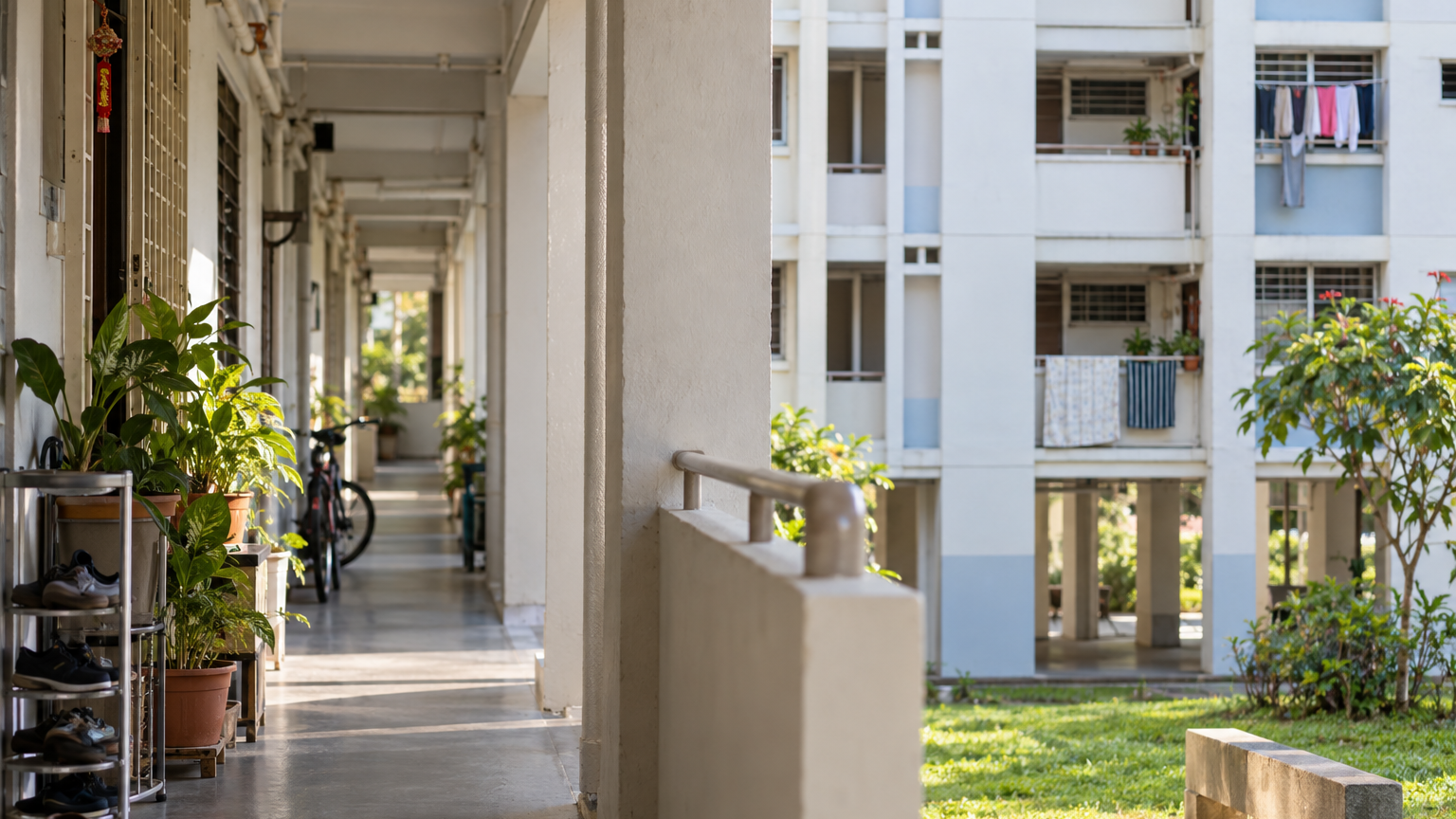
A 50-year-old private condominium will eventually need 70% consent, instead of 80%, to pursue a collective sale under Singapore’s amended strata law. An HDB block of the same age gets no matching owner-led route: flat owners cannot start an estate-wide sale simply by gathering enough neighbours’ signatures.[S1][S2]
That distinction matters to anyone counting on an ageing HDB estate to produce a future payout or replacement home. The private-property reform changes how owners may agree to sell collectively; HDB renewal still depends on separate government programmes, while an owner who wants to move now generally has to plan around an ordinary resale transaction.[S1][S2]
What changes for older condos
Parliament passed the Land Titles (Strata) (Amendment) Act 2026 on 8 September 2026. It received Presidential assent on 24 September and was published on 2 October, but its collective-sale changes will begin only on a date appointed by the Minister through a Gazette notification.[S1]
Once they take effect, the consent thresholds will depend more sharply on a development’s age:
| Development age | Required consent |
|---|---|
| Under 10 years | 90% |
| 10 to under 40 years | 80% |
| 40 to under 60 years | 70% |
| 60 years or older | 65% |
Consent is measured by both share value and total strata area—not simply by counting households. The amended regime will also require 35% support to call a meeting to form a collective-sale committee, shorten the signature-gathering period from 12 months to six, and generally extend the restriction following a failed attempt from two years to three.[S1]
The policy is meant to give ageing private developments facing substantial repair, maintenance or upgrading needs a more workable redevelopment option, while retaining safeguards for owners who do not consent.[S3] But a lower voting threshold only makes collective agreement easier. It does not ensure that a developer will bid, that the price will satisfy owners or that redevelopment will make financial sense.
Why this does not create an HDB en-bloc option
HDB owners do not collectively own their estate’s land and common property through the same strata framework as private-condo owners. The amended law therefore does not give residents of an older HDB block a vote to put the whole site up for sale.[S1][S2]
The Selective En bloc Redevelopment Scheme, or SERS, works differently. HDB identifies selected sites for redevelopment; it is not a process that residents can initiate by reaching a prescribed consent percentage.[S2]
Where SERS applies, the compensation and rehousing arrangements are tied to that specific exercise. HDB’s published programme information covers matters such as compensation for the acquired flat and rehousing benefits, but it does not establish a general entitlement for every ageing estate.[S2]
So an owner should not treat possible SERS selection—or any future renewal model whose detailed terms have not been announced—as money already available for the next home. The practical choices today remain selling through the resale market, continuing to live in the flat, or considering an existing HDB monetisation or housing option for which the household qualifies.
If you may move, check these four things first
1. Whether you can sell yet. HDB owners must satisfy the Minimum Occupation Period, or MOP, and other applicable sale conditions. Most existing subsidised and resale flats have a five-year MOP, while flats sold under the Plus and Prime classifications carry a 10-year MOP; resale eligibility can also be affected by the Ethnic Integration Policy and Singapore Permanent Resident quotas.[S4]
2. Your eligibility for the replacement home. If you intend to buy another resale flat, obtain a valid HDB Flat Eligibility letter before the seller grants you an Option to Purchase. The HFE letter assesses your eligibility to buy a flat, receive housing grants and take an HDB loan, where applicable.[S5]
An HFE letter is not a valuation of the flat you are considering. It also should not be read as confirmation that every possible purchase price, CPF amount or monthly repayment will suit your household.
3. How the remaining lease affects financing. CPF says the amount of savings usable for a property may be pro-rated when it has at least 20 years of lease left but cannot cover the youngest buyer until age 95.[S6] HDB similarly states that its maximum loan-to-value limit is pro-rated when the lease does not cover the youngest core member to age 95.[S7]
This can make an older replacement flat harder to finance even if its advertised price looks manageable. Two households considering the same unit may have different usable CPF amounts or loan limits because their ages and financial circumstances differ.[S6][S7]
4. The timing and net proceeds of both transactions. A useful household estimate starts with the expected sale price, then accounts for the outstanding housing loan, CPF-related amounts and transaction expenses before comparing the balance with the purchase cost and financing available for the next home. CPF provides a housing-usage calculator for planning, but the result remains an estimate rather than an official valuation or final transaction statement.[S8]
That sequence is an indicative planning exercise, not an HDB eligibility decision. Actual proceeds, CPF treatment, grants, valuation and loan approval depend on the household and the eventual transactions.
The important split is now clearer
Owners of some older private developments will have a lower collective-sale voting hurdle when the amended law commences. HDB owners have received no equivalent button to press.[S1][S2]
For a household deciding whether to move, the dependable numbers are therefore the ones it can verify now: MOP status, HFE assessment, likely resale proceeds, usable CPF savings, financing limits and the replacement flat’s remaining lease. A hoped-for renewal payout should stay outside the moving budget unless and until HDB announces that the estate is covered by a specific programme.
Sources
- CPF housing usage calculator · Central Provident Fund Board
- CPF use when a property lease does not cover the youngest buyer to age 95 · Central Provident Fund Board
- Application for an HDB Flat Eligibility (HFE) letter · Housing & Development Board
- Eligibility to sell an HDB flat · Housing & Development Board
- Mode of financing for an HDB resale flat · Housing & Development Board
- Selective En bloc Redevelopment Scheme (SERS) · Housing & Development Board
- Proposed Amendments to the Collective Sale Regime to Support Renewal of Ageing Developments and Strengthen Owner Safeguards · Ministry of Law
- Land Titles (Strata) (Amendment) Act 2026 · Singapore Statutes Online