Sin Ming and Toa Payoh Flats Are Being Built Before Their Sale
The 1,269 homes could offer shorter waits, but their application dates, prices, classification and flat mix remain unannounced.
Published 2026-10-08 · 6 min read
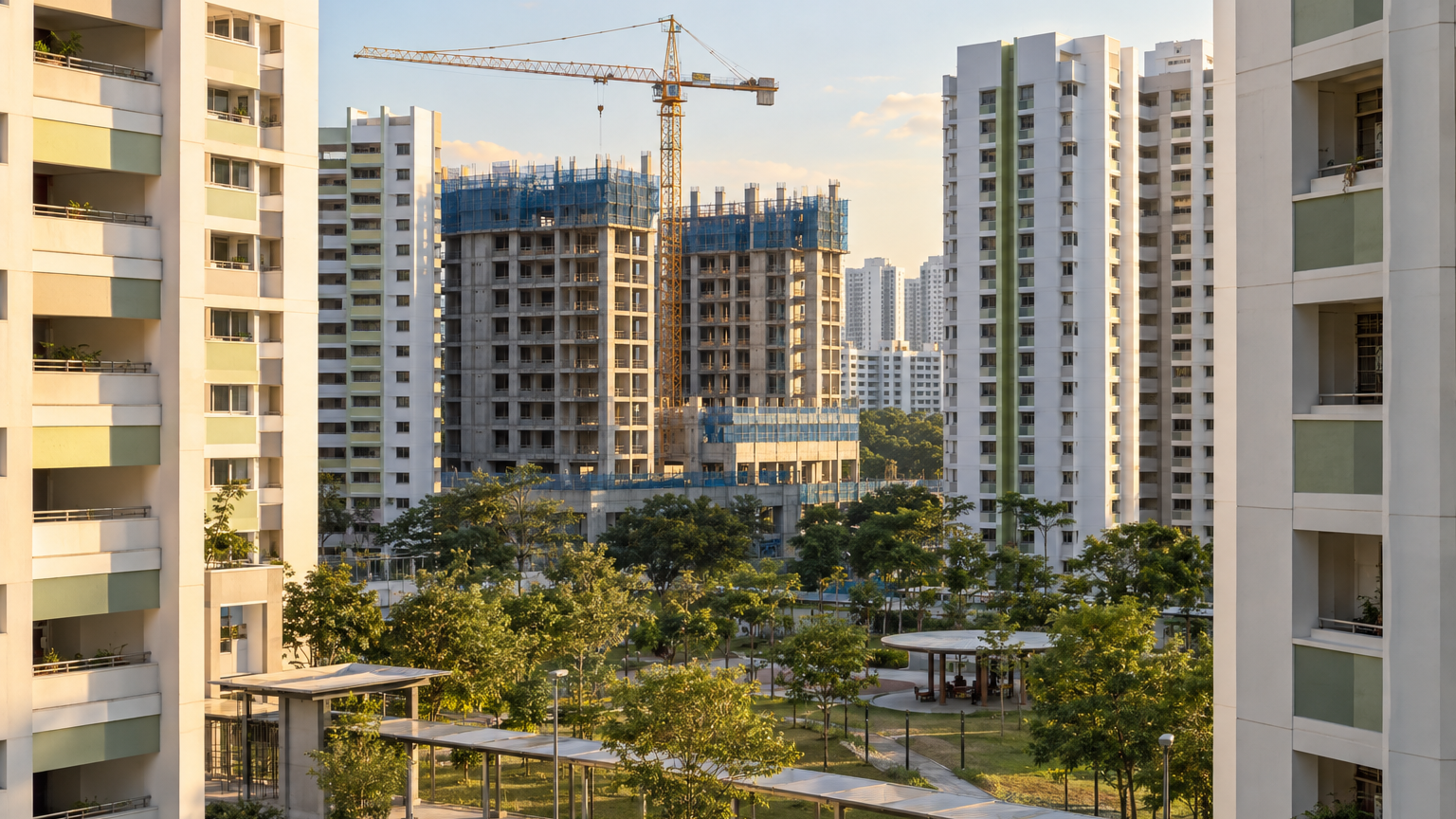
Construction has started on 1,076 flats at Sin Ming Street and another 193 flats in a 40-storey block at Lorong 4 Toa Payoh. Both projects are expected to be completed around mid-2030, although HDB has not announced when people can apply for them.[S1]
That unusual sequence—building first, selling later—could eventually shorten the wait for successful applicants. But for households planning their next move, the visible construction does not yet answer the important questions: who will qualify, what the flats will cost, when keys will be ready and how an existing home fits into the move.
Why people are talking about 2027
HDB has previously described shorter-wait flats as those with waiting times of under three years. Starting construction before a Build-to-Order, or BTO, sales exercise is one way to compress the period between booking a flat and collecting the keys.[S2]
An indicative planning calculation explains the talk of a possible 2027 launch. Counting back roughly three years from the projects’ reported mid-2030 completion target points to around mid-2027. But that is arithmetic, not an HDB sales announcement. HDB has said that the launch dates and estimated waiting times will be released later.[S1]
Applicants should therefore avoid treating mid-2027 as a deadline—or mid-2030 as their personal key-collection date. A project’s construction completion, an applicant’s flat-booking appointment and the eventual key handover are different milestones.
There are also major gaps that matter to a household budget. HDB has not announced the flat types, selling prices, project classification or exact conditions for either development.[S1] The Sin Ming project is expected to include a childcare centre and supermarket, while the Toa Payoh development is planned with a multi-storey car park, roof garden, precinct pavilion and community facilities.[S1]
Those details make the sites easier to picture, but they are not enough to compare affordability or value. Nearby resale transactions cannot tell you the price HDB will set, the grant your household may receive or the loan amount it may qualify for.
Your household—not your preferred estate—determines eligibility
A couple may like Sin Ming or Toa Payoh and still be unable to apply under the eventual sales conditions. Under current rules for couples and families, applicants generally need to form an eligible family unit, meet citizenship and age requirements, stay within the applicable income ceiling and obtain a valid HDB Flat Eligibility letter before submitting a flat application.[S3]
The HFE letter is HDB’s assessment of a household’s eligibility to buy a flat, receive housing grants and take an HDB housing loan. It is based on the household’s circumstances and the rules in force when assessed.[S3]
This creates a timing issue. A household hoping for these projects may change before applications open: incomes can rise, a couple may marry, a child may arrive or an existing property may be sold. An HFE assessment made nearer the actual exercise will matter more than a rough self-check today.
Household members included to qualify for a flat are also not merely names on an application. They generally have to live in the home throughout the applicable minimum occupation period, or MOP.[S3] Because HDB has not announced the classification of these projects, buyers should wait for the sales conditions before assuming what MOP will apply.[S1]
Existing owners need to calculate usable proceeds
If you already own a flat, the selling price is not the same as the cash available for your next home. The sale proceeds first go towards paying off the outstanding housing loan and refunding CPF savings used for the property, together with the accrued interest those savings would otherwise have earned.[S4]
A simple planning equation is:
Selling price − outstanding loan − required CPF refund − selling costs = estimated cash proceeds
This is only a household estimate, not an official valuation or financial assessment. The actual figures depend on the eventual sale price, loan balance, CPF usage and transaction costs.
The CPF refund is not necessarily lost money: it returns to the owner’s CPF account and may potentially be used for another home, subject to the applicable CPF housing rules. If a property is sold at market value and the proceeds are insufficient to make the full required CPF refund, CPF says the seller generally does not need to top up the shortfall in cash.[S4]
Move timing can be just as important as proceeds. Selling early may create a need for rental accommodation or another temporary arrangement. Selling late may leave too little time to complete the transaction or finance the new flat. Until HDB announces the application and completion schedule, owners cannot reliably fix that handover sequence.
Buying a resale flat now is a different commitment
Some households may be deciding whether to wait or buy a resale flat sooner. That is not simply a comparison between an unknown BTO price and today’s resale asking prices.
A resale buyer receives an existing home sooner, but takes on its remaining lease and current purchase conditions. CPF usage is generally allowed only when a property has more than 20 years left on its lease. If the lease does not cover the youngest buyer until age 95, the amount of CPF savings that can be used may be reduced proportionately.[S5]
A resale purchase can also restrict a later move. Under the current terms for an HDB resale flat, owners generally must occupy it for a five-year MOP before selling it on the open market or renting out the whole unit.[S6] Someone buying resale as a short bridge to these future projects could therefore discover that the bridge lasts longer than expected.
The sensible comparison is wider: housing needs now, remaining lease, allowable CPF use, loan size, renovation spending and the earliest realistic date for another move. The two unlaunched projects should be treated as a possible future choice—not a confirmed solution to an immediate housing need.
What you can prepare before HDB opens applications
You cannot yet choose a flat or calculate its affordability accurately. You can, however, prepare the information that will shape the decision:
- Check whether your intended household structure fits HDB’s current family eligibility rules.[S3]
- Review your outstanding mortgage and CPF property transactions rather than relying on an estimated resale profit.[S4]
- If considering resale instead, check the remaining lease and how it affects CPF usage.[S5]
- Map the period for which your present home remains suitable, including children, caregiving and rental needs.
- Wait for HDB’s official flat mix, prices, classification, application dates and estimated waiting time before making a project-specific commitment.[S1]
For now, the concrete works provide one useful clue: successful buyers may spend less time waiting after booking than they would for a project launched before construction. The bigger decision—whether either project actually suits your household—can only begin when HDB publishes the sales details.
Sources
- How much CPF OA savings can you use when buying your next home? · Central Provident Fund Board
- How much CPF savings can I use if the lease does not cover the youngest buyer to age 95? · Central Provident Fund Board
- 19,600 BTO Flats to be Launched in 2024 Across Three Sales Exercises · Housing & Development Board
- Couples and Families · Housing & Development Board
- Terms and Conditions of Sale and Purchase of an HDB Resale Flat · Housing & Development Board
- Flats with shorter waiting times being built in Sin Ming and Toa Payoh · The Straits Times